What is DEX?
DEX is a single agentic platform where an entire IT delivery team works together to take software from idea to production.
That's the one sentence. Everything else is detail.
One platform, every role
A normal software team has a lot of distinct roles: product owner, project manager, delivery manager, architect, front-end engineer, back-end engineer, integration engineer, security engineer, QA manager, site reliability engineer, DevOps/SRE, and monitoring & support engineer.
Today, those roles work across a dozen disconnected tools. DEX puts all of them — humans and AI agents standing in for humans — on one platform, working against one shared spec and one shared codebase.
One platform, the whole lifecycle
DEX covers the full software development lifecycle (SDLC):
Design → Plan → Develop → Build → Test → Deploy → Monitor
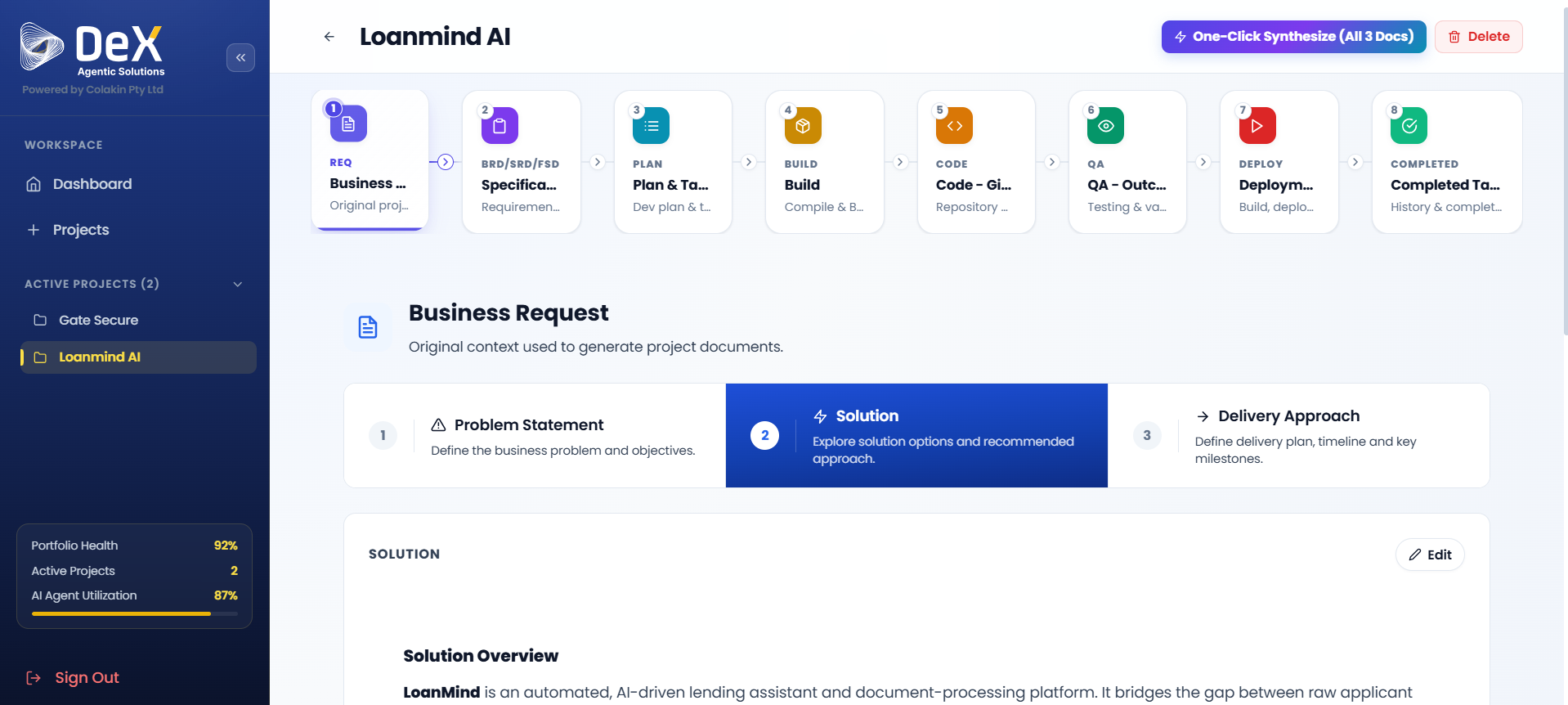
Instead of stitching together a design tool, a ticketing tool, a CI/CD pipeline, a test suite, and a monitoring dashboard, a team runs the whole cycle inside DEX.
Mostly agents, a few humans
Here's the structural shift DEX makes possible: most of the work in that lifecycle can be done by an agent — a piece of software that impersonates a role (e.g. "QA Engineer agent," "Front-end Engineer agent") and does the work that role would normally do.
A team that used to need 12 people can run with 2 humans directing roughly 10 agents. The humans stay in the loop for judgment calls, approvals, and anything that needs real accountability; the agents do the repetitive, well-specified work.
What DEX is not
People naturally compare DEX to coding copilots and AI IDEs. It's a useful comparison to rule out:
- DEX is not a code-completion tool like Cursor, Copilot, or a CLI coding agent.
- DEX is not a single-purpose point solution that does "one thing end-to-end" the way a narrow automation tool might.
DEX is a delivery platform: it takes a customer's problem and a proposed solution, and carries that all the way through to working, deployed, monitored software — with a human in the loop and a growing knowledge base behind it.
Spec-driven is the operating principle
The most important phrase to remember about DEX is spec-driven.
You don't write code first. You write the spec — in plain English — describing the business problem and the intended solution. DEX translates that plain-English spec into:
- Requirements documents (BRD, SRS, FSD)
- A development plan and task breakdown
- Working code
- Tests
- A deployed, monitored release
If you know the business problem well enough to describe it clearly in plain English, DEX can carry it the rest of the way.